
“For four color separation lithography, I prefer using the triple roller invented by Nik Semenoff. This roller eliminates lap marks, which is particularly important in printing halftone images.”
– Dwight Pogue,
Artist/Printmaker
Take a closer look.
Conrad Machine Co. is proud to introduce the revolutionary 3-Part Roller inking system. Originally, invented by Nik Semenoff; world-renowned printmaker, teacher, and inventor; the 3-Part Roller is designed to help overcome tinting in waterless lithography and print traditional gum etch lithography with colored inks.
The innovative 3-Part Roller allows printmakers to easily print uniform editions using traditionally difficult colors.

Conrad 3-Part Inking Roller Design
It Just Makes Sense.
After years of research and many prototypes, Nik Semenoff’s original design is simple, easy-to-use, and effortless.
Before the 3-Part Roller, most printmakers used small diameter brayers for greater lift and to pick up loose ink off their plates, but small brayers couldn’t hold enough ink for efficient editions.
Semenoff’s design combines the utility of a smaller diameter brayer with the capacity of a large roller.
The roller consists of two rubber rollers that contact the ink slab and plate.

3-Part Inking Roller Use
How it Works.

Ink is transferred from the two rubber rollers to the larger steel tubular roller. The total circumference of all three rollers in the 3-part roller is 17.25″, which is 37% more ink-holding surface than the average 4″ roller used in most print shops and studios.
Because of the multiple inking surfaces, the 3-part roller can fully distribute the ink across the slab evenly with only a few passes as compared with a traditional roller that may take 10-15 passes.
With a 15″ wide 3-Part Roller, large plates can be quickly rolled up and flats can be more even in ink coverage. Printmakers no longer have to choose between small and large rollers.
Conrad 3-Part Roller Construction
Premium Materials.
The rubber rollers are manufactured from the best LHB (HT) Nitrile material available, producing a system that will last for years. The tubular roller is constructed from DOM (Drawn Over Mandrel) steel that is precision machined to produce an even layer of ink on the plate.
A central wooden core runs through the tubular roller, providing support for the entire system. It is made from two pieces glued together to prevent warping and roller misalignment. Handles at each end are screwed on a threaded rod to hold the system together.

3-Part Inking Roller Purpose
Waterless Lithography.
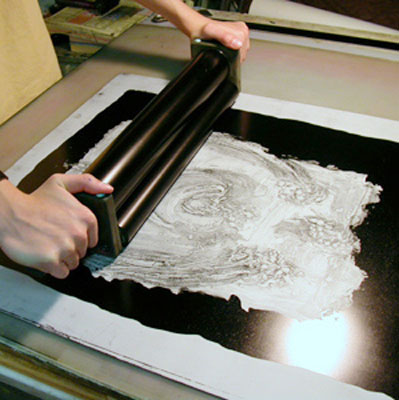
Waterless lithography is a new technology that is becoming increasingly important and popular for printmakers in North America and the rest of the world.
Many printmakers have trouble using traditional brayers for waterless lithography. The best detail from a waterless plate comes from looser inks that pick up the most delicate tints while preventing ink squash and darkening in the richer areas.
The 3-Part Roller performs effortlessly in this situation. The many surfaces on the 3-Part Roller even out overlaps and produce a better image. When used with a proper siliconed subplate, the inking area can be kept clean with less likelihood of getting unwanted ink on your prints.
Conrad 3-Part Inking Roller Advantages
Inking will never be the same.
Color Separation Lithography
The 3-Part Roller can also be effectively used for traditional lithography, as the ink deposits are better because of the multiple rollers. It is especially useful for the hard to print yellow and red inks.
Easier on Your Hands
It is being used by a number of printmakers who print in traditional lithography exclusively. Printmakers also love the 3-Part Roller because it will not produce blisters on your hands, as the handles do not turn while the roller is rolled across the plate.
Faster, Easier Ink Distribution/Rollout
The 3-part roller is 60%-75% more efficient at rolling out ink on a slab than traditional rollers. With only a few passes, the ink will be rolled consistently across the entire slab.

Eliminates Lap Marks
One of the biggest advantages of a Conrad 3-part ink roller is how it helps eliminate lap marks, giving you a much smoother, more even ink layer.
With a standard roller, each pass can slightly overlap the previous one, creating visible lines or uneven buildup—what printmakers call lap marks. This is especially noticeable on larger plates or when working with solid areas of color.
The 3-part roller solves this by allowing each section of the roller to move independently, similar to how rollers are designed in traditional letterpress equipment. As you roll across the plate, the sections naturally adjust and distribute ink more evenly, preventing those overlapping lines from forming.
The result is a clean, uniform ink surface with no streaks or inconsistencies. Whether you’re working on detailed imagery or large, solid fields, you get smoother coverage and more professional results—just like the even inking you’d expect from a letterpress setup.
Lithographic 3-Part Roller Care & Maintenance
So Easy to Clean.

Cleaning your 3-Part Roller is easy. Simply take a well-scraped ink slab and apply a solvent free solution.
Roll your 3-Part Roller on the slab, and then roll the diluted ink onto old newsprint.
Disassembling the roller is seldom necessary for regular cleaning.
Conrad 3-Part Inking Roller Specifications
Made just for You.
Rubber roller face lengths: 12″, 15″, 20″
Rubber roller diameter: 1.5″
Roller durometer: 40 – 45 LHB (HI) Nitrile rubber.
Steel tube roller is 2.5″ diameter
Polycarbonate bearings support the roller shafts.
Rubber roller shafts are .45″ in diameter for greater strength.
Roller system weighs about 11 pounds.
Get a Conrad 3-Part Inking Roller
There’s never been
a better time to print.
If you want smooth, even ink coverage and better control on every plate, the Conrad 3-part roller is the tool to get there.
Designed for precision and consistency, it helps you lay down ink exactly the way you need it—no lap marks, no guesswork.
Take the next step in your printmaking setup.
Shop Conrad Inking Rollers NowFAQ
A 3-part ink roller is made up of three independently moving sections. This design helps distribute ink more evenly across the plate and reduces common issues like streaks or lap marks.
Because each section moves independently, the roller naturally evens out overlaps as you roll. This prevents the buildup lines that can happen with standard rollers, giving you a smoother ink surface.
The 3-part roller was originally designed for waterless lithography, but it also works great for intaglio, relief, monotype, and any process where smooth, even ink coverage is important—especially on larger plates or solid areas.
Yes. A standard roller has one solid roller, which can create uneven ink distribution. The 3-part design has three individual rollers that allows for more consistent coverage and better control, similar to what you’d find in letterpress inking systems.
No. It works just like a regular roller—no special setup required.
